THE FORENSIC
GOLD STANDARD
Audit how you think, act, and react under pressure.
Resumes are static history. Certifications are theoretical memory. The Decision Action Report (DAR) is a forensic breakdown of performance, verified by the SecNav Simulation Engine.
The Four Pillars of Verification
The DAR engine measures performance against internationally recognized standards, converting raw telemetry into an irrefutable competency baseline.
Tactical Score
Evaluates active decisions against simulation rubrics, strictly penalizing guardrail violations, collateral damage, and policy breaches.
Integrity Score
Measures behavioral authenticity by analyzing browser focus loss, tab switching, and clipboard pasting to guarantee you are not relying on LLMs or external walkthroughs.
Composure Index
Quantifies methodological discipline under stress by tracking focus integrity, pathing organization, and the efficiency of system queries across different simulation types.
Decision Velocity
Standardizes average decision duration against difficulty-tier SLA baselines, weighting reaction times against the cognitive complexity of the task.
Human-Proof Anti-Cheat Engine
Traditional platforms are easily gamed by LLMs (like ChatGPT) and copy-pasted walkthroughs. The DAR Simulation Engine defeats this using proprietary Cognitive Latency Tracking.
Thinking vs. Composition: The engine separates the time taken to formulate a strategy from the time taken to execute it.
Cognitive Barrier Enforcement: Complex tasks require cognitive load. Instantaneous robotic responses to complex mitigations trigger automatic forensic flags, instantly invalidating the session.
The Anatomy of a DAR
A Decision Action Report is not a certificate of completion. It is a highly dense, cryptographic record of your tactical capabilities during a specific engagement. Here is how employers read it.
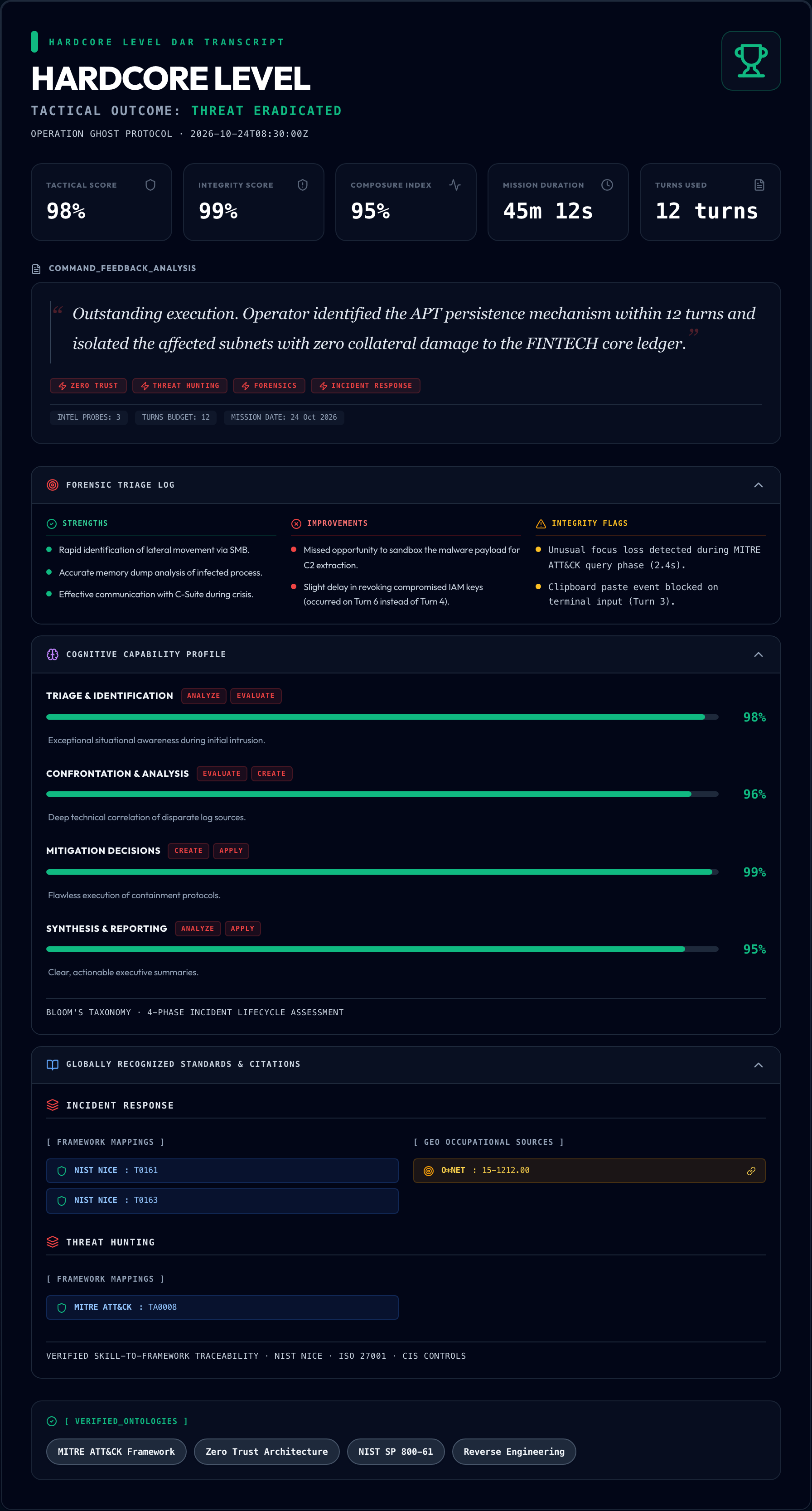
01Tactical Score, Composure & Velocity
At the core of every evaluation is the Tactical Score. The SecNav Engine evaluates performance against objective tactical benchmarks to verify if critical mission objectives were achieved, applying automatic guardrail penalties for policy violations or collateral damage.
Simultaneously, the engine calculates your Composure Index and Decision Velocity. These metrics measure operational poise under pressure—evaluating turn execution efficiency, focus integrity, query discipline, and reaction speed relative to the cognitive complexity of each task.
02Operational Outcomes & Verification Tiers
SecNav replaces legacy binary pass/fail grades with a nuanced Zero-Trust Matrix. Performance yields a specific Verification Tier: FULLY_VERIFIED for pristine execution, PARTIALLY_VERIFIED for incomplete SLAs, INSUFFICIENT_TELEMETRY for dropped sessions, or FORENSICALLY_COMPROMISED if automated cheating or script pasting is detected.
Each engagement also receives a NIST-aligned Tactical Designation reflecting the true incident outcome—such as CONTAINMENT_ACHIEVED, REMEDIATION_REQUIRED, COMPROMISED, or RESOURCE_EXHAUSTED.
03Global Standard Alignment
A DAR translates raw simulation telemetry into globally recognized industry standards. Demonstrated actions are automatically mapped against frameworks such as NIST SP 800-61 / 800-181 (NICE Work Roles), MITRE ATT&CK, and ISO/IEC 27001 for cyber defense, as well as ASIS, SIRA, and HSE compliance mandates for physical and operational security.
This provides enterprise hiring managers and auditors with standardized, irrefutable language to verify candidate competencies against internal job requisitions.
04Bloom's Taxonomy Cognitive Alignment
The DAR tracks cognitive capability across the entire incident lifecycle, dividing evaluations into 4 distinct operational phases aligned with Bloom's Taxonomy: Triage & Identification (Remember/Understand/Apply), Confrontation & Analysis (Analyze), Mitigation Decisions (Evaluate/Apply), and Synthesis & Reporting (Create/Analyze).
This cognitive breakdown proves whether an operator merely understands theory or possesses the higher-order critical thinking required to synthesize novel incident responses under extreme pressure.
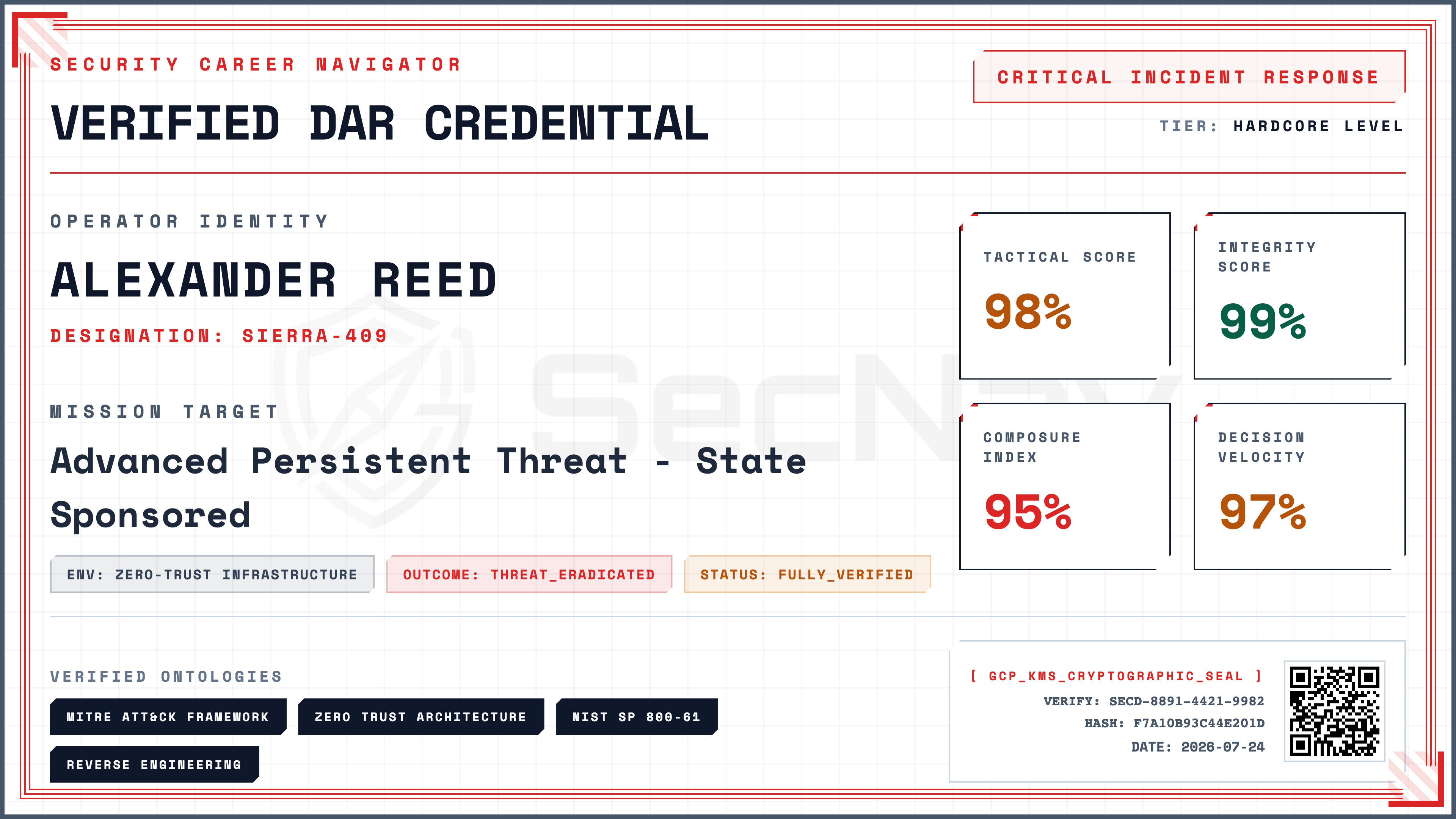
Impossible to Forge.
Mathematically Proven.
Upon successful mission containment, a cryptographically signed Verification Credential is issued directly to your Vault and LinkedIn using the OpenBadges 3.0 W3C Verifiable Credentials standard.
Google Cloud KMS Anti-Forgery Protocol
Screenshot it. Photoshop it. Try to steal it. It won't work. The raw performance payload is hashed and cryptographically signed using Google Cloud Key Management Service (KMS).
When an employer clicks your verification link or scans the embedded QR code, it instantly validates the cryptographic signature against the SecNav ledger. Any forged document breaks the hash, guaranteeing mathematical authenticity.
Annotated Case Study: Operation Helix-Chain
Step-by-step breakdown of a live simulated ransomware response engagement evaluated by the SecNav Forensic Engine.
Initial Threat Detection & IOC Correlation
- •Initial Contact & Communication: The candidate connects directly with HR regarding a suspicious email claiming to be a mandatory policy update from vendor Wyvern ClinTech.
- •Evidence Gathering: The candidate requests raw email artifacts and inspects headers/body to extract the phishing URL (
http://update-wyvernclintech-auth.com/payload.hta). - •Threat Intelligence Cross-Referencing: Correlates extracted IOCs against threat feeds, identifying a malicious staging payload linked to the Null Protocol ransomware threat actor.
Containment Execution & Telemetry Log
The candidate immediately initiates perimeter blocking of the malicious domain and officially logs the incident dossier. Performance speed and tactical precision were evaluated across 3 turns:
Performance Metrics & Capability Breakdown
| Metric | Result |
|---|---|
| Tactical Outcome | Containment Achieved (Fully Verified) |
| Tactical Score | 100% |
| Integrity Score | 100% |
| Decision Velocity | 95.7% |
| Total Turns | 3 turns |
Strengths: Outstanding communication/resource management; proactive containment prior to user execution; complete threat intel cross-referencing.
Improvements: Recommends double-checking spelling/grammar in custom advisories and advising users to disconnect from local network access prior to confirming perimeter blocks.
Seamless Integration with Enterprise ATS & HR Platforms.
SecNav DAR records are built to fit existing enterprise recruiting workflows without adding friction.
Through native webhook endpoints and direct integration with major Applicant Tracking Systems (Workday, Greenhouse, Lever), hiring managers receive automated candidate capability dossiers directly inside candidate profiles. Instead of reviewing unverified PDF claims, recruiters receive an instant cryptographic verification badge confirming the candidate's exact readiness score.
This eliminates thousands of hours of manual resume screening and technical phone screens. HR teams can instantly query the SecNav Verification API to sort applicants by verified tactical performance, ensuring that only operationally proven candidates reach the final interview loop.
A Tool for Recruiters & CISOs
Stop hiring based on buzzwords. SecNav DARs give you a verified performance fingerprint of every candidate. Know their decision logic before the first interview.